
Building a Better TH400: Why the Details Matter
Posted by Eric Holliday on 15th Sep 2026
Building a Better TH400: Why the Details Matter
When people shop for a performance Turbo 400, the conversation usually starts with horsepower.
“How much power will it hold?”
That's obviously an important question, but there's a lot more that goes into building a TH400 for a serious racing application than installing a collection of billet parts and putting a horsepower rating on it.
Hard-part selection matters. But so do line pressure, converter charge pressure, converter exhaust, fluid volume and ultimately how the transmission and torque converter work together as a complete system.
For us, that's especially important because so many of our combinations are behind Ford Modular and Coyote engines, where taking care of the engine's thrust system is something we pay very close attention to.
How do you determine the horsepower rating of a TH400?
Obviously, when we're building a Turbo 400 for a specific power range, parts selection is a key component.
If I tell a customer that I expect a transmission to support 1,500 horsepower, we're going to select and install components that we realistically believe will support north of 1,500 horsepower.
There needs to be some cushion built into that number.
Nobody wants to buy a transmission rated for 1,500 horsepower and find out that its actual limit is 1,501.
But once we've established that the hard parts are capable of supporting the intended power level, there's another side of the transmission that becomes extremely important: making sure the entire system operates correctly.
Once you've selected the right hard parts, what's next?
Once we've selected components that will physically support the power, the next step is making sure the transmission and torque converter are actually going to operate correctly together.
That's where the hydraulic side of the TH400 becomes extremely important.
A large percentage of the applications we deal with are Modular Ford and Coyote combinations, and these engines have a relatively sensitive thrust system. We don't want the transmission unnecessarily pushing forward on the torque converter and ultimately loading the crankshaft thrust bearing.
Because of that, we pay very close attention to line pressure, converter feed, converter exhaust and pressure regulation.
We're not just asking, “How much pressure does this transmission make?”
We're looking at how much oil we're putting into the converter, how quickly we're putting it there, and whether we're giving that oil an adequate path back out.
The goal is to give the converter the oil it needs to operate correctly without unnecessarily loading the converter or the engine's thrust system.
This is also one of the reasons we offer The split-circuit setup. Instead of simply relying on the traditional internal circuit, we can create a system that gives us considerably more control over how the converter is supplied with oil based on what that particular converter requires.
What happens when a converter is overfed or can't exhaust enough oil?
There are actually two sides to this problem.
You can overfeed the converter, or you can under-exhaust the converter.
They're different problems, but they can produce essentially the same result.
If we're putting too much oil into the converter, not allowing enough oil to leave it, or have some combination of the two, pressure builds inside the converter. That pressure can physically force the converter forward toward the engine.
Now we're applying forward force against the crankshaft and its thrust bearing.
Historically, converter ballooning could also be part of the problem. We don't see that nearly as frequently with today's quality performance converters because of anti-ballooning plates and improvements in converter construction, but excessive internal pressure still isn't something we want.
And engine thrust damage isn't the only concern.
A converter that is being overfed or can't adequately exhaust isn't necessarily going to operate the way it was designed to operate.
That's why we don't look at converter charge by itself. We look at the complete circuit.
Isn't cooler-line pressure the same thing as converter charge?
This is an area where people can get overly focused on one measurement.
On a Turbo 400, people tend to put a lot of emphasis on what they see at the cooler line because it's easily accessible. But we're interested in the entire system—what's going into the converter as well as what's coming out of it.
Over the years we've spent a lot of time looking at how much fluid different converter combinations actually require.
We've tested things, documented the results, compared combinations and continually refined what works and what doesn't.
That's an area where I believe we've really excelled with Coyote combinations.
Instead of treating every converter exactly the same, we're trying to understand what that particular converter needs.
Does converter size change its fluid requirements?
Absolutely.
We have combinations that we use repeatedly, and with those packages we already have a very good understanding of where we need to start.
If you buy a complete transmission and torque-converter package from us, chances are it's a combination we've worked with over and over again. We know the converter, we know the transmission setup and we have a baseline for the oil requirements of that package.
If you're buying only a transmission and supplying your own converter, that's fine too.
In that situation, we'll generally set the fluid system somewhere in the middle of the usable flow range. We don't want to start by giving the converter too much oil, but we certainly don't want to starve it either.
Then, if the customer has the appropriate data and wants to work with us, we can look at what the car is actually doing and make changes to better suit that specific combination.
Converter capacity matters.
We need enough flow to help control temperature, maintain the appropriate charge pressure and, most importantly, allow the converter to operate correctly.
There isn't necessarily one converter-feed calibration that's perfect for every TH400 and every converter.
What data should you log to properly evaluate a TH400 and torque converter?
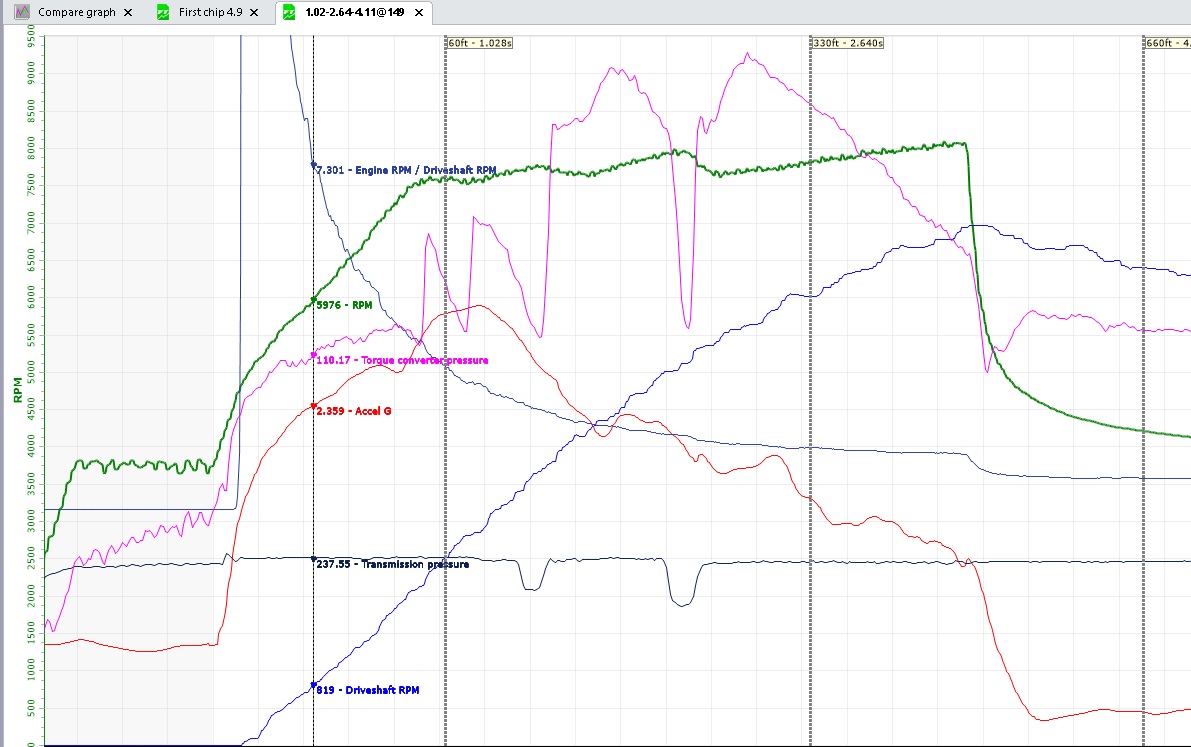
If somebody really wants to get the most out of their transmission and torque-converter combination, there are several channels I'd love to have:
-
Line pressure
-
Converter charge pressure
-
Driveshaft speed
-
Engine RPM
-
G-meter/acceleration data
With those channels, we can start looking at what the entire combination is doing rather than basing decisions on one number.
A perfect example is RPM drop on the gear change.
People put a tremendous amount of emphasis on gear drop when evaluating a torque converter. And gear drop isn't useless information. If that's the only information you have, then absolutely use it.
But once we have driveshaft speed, G-meter data, engine RPM and pressure information, gear drop becomes a relatively small piece of a much larger puzzle.
Isn't more RPM drop on the shift evidence of a tighter, better converter?
Not necessarily.
Obviously, there's a point where something is clearly wrong. If we're shifting an engine at 8,200 RPM and it falls all the way to 5,500 RPM on the gear change, that's something we're going to investigate.
But then you'll hear someone say:
“My converter only drops 300 RPM on the shift. It's too loose. I need to tighten it.”
Maybe.
But maybe not.
Suppose we tighten that converter until we're seeing less than 10% slip toward the top of first or second gear. That sounds great if converter slip percentage is the only number we're chasing.
But what happens if that tighter converter starts putting substantially more load on the engine?
Now look at engine acceleration.
Then look at the G-meter.
If the engine stops accelerating as hard and the car stops accelerating as hard, did we actually make the combination better simply because the converter-slip number looks better?
No.
Depending on the engine and converter combination, that particular package may be happier with only 100 or 200 RPM of drop across the shift because keeping the engine in that operating window allows the entire vehicle to accelerate harder.
That's ultimately what we're trying to accomplish.
We're not racing a converter-slip number.
We're racing the car.
What's next?
There's still a lot more happening inside a properly prepared Turbo 400.
Next we'll get deeper into the transmission itself: the pump and pressure-regulator system, converter-feed and exhaust circuits, our split-circuit configuration, internal lubrication, clutch apply and the other modifications we make to get the entire package working together.
Because at this level, building a TH400 isn't simply about finding parts strong enough to survive the horsepower.
The hard parts have to survive the power—but the hydraulic system has to make everything work.